How Meeting Minutes Carry Decisions Between Gatherings
Learn how meeting minutes carry decisions between gatherings, record open questions fairly and help a community group continue its work without relying on memory.
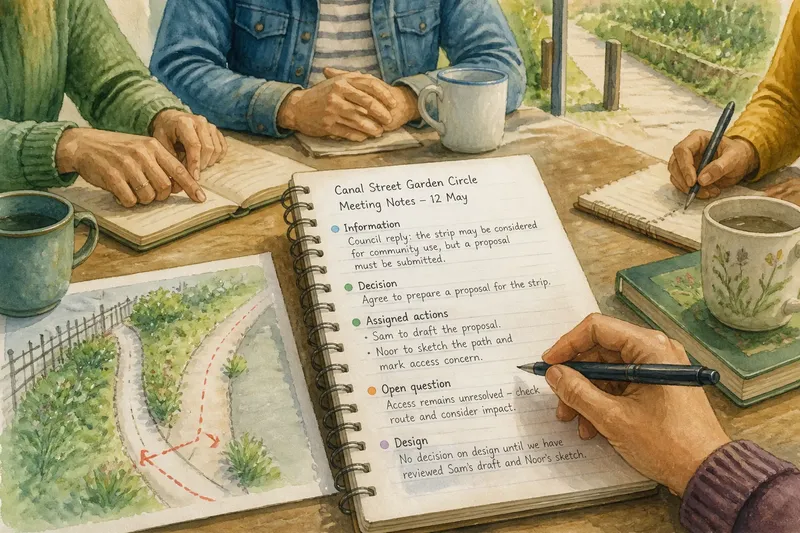
Meeting minutes keep a community decision usable after everyone has left the room. For a local group, the record matters most when people need to tell what was agreed, what remains open and who is taking the next action.
Imagine a fictional neighbourhood group, the Canal Street Garden Circle, discussing a neglected strip beside a footpath. Some members want a shared growing space; others are unsure about access and permission. Their minutes need to preserve that distinction, not turn an early conversation into a settled plan.
What belongs in a record of a shared decision?
A useful record is not a transcript. It captures the decision, the reasoning needed to understand it, any important disagreement and the actions the group actually assigned. That makes it possible for an absent member to rejoin the work without relying on someone else’s memory.
For the Garden Circle, “the group discussed the strip” would leave too much guesswork. “The group agreed to ask the council who manages the strip and what permission is needed” records a clear outcome. If no permission has been given, the minutes should not imply otherwise.
Write the decision in plain language, then separate it from the work that follows. A decision might be to prepare a proposal; an action might be for one named member to draft it. A question about access can remain open without being disguised as agreement.
How can minutes preserve uncertainty and disagreement?
A tidy record can still be misleading if it makes a contested decision sound unanimous. Minutes do not need to name every speaker or capture every remark, but they should retain a concern that affects the choice or the next step.
Say the fictional Garden Circle considers raised beds beside the footpath. One member worries they could obstruct access, while others want to develop a proposal. The group decides to check the route before choosing a design. Its minutes can record the access concern and the agreed check without attributing motives or pretending the design has been settled.
Use neutral wording: “Members raised concerns about access” describes the issue without judgement. If the group votes, record the outcome according to its agreed practice. If it reaches no decision, say so and identify what information or discussion is still needed.
What practical questions do people ask about meeting minutes?
Are meeting minutes a transcript?
No: minutes usually select the decisions, actions and context the group needs to refer to later. A group can choose a fuller record if its responsibilities call for more detail.
Who should take the minutes?
The group can assign the role to a secretary, rotate it or agree another arrangement. Whoever writes the record needs to know what the group expects it to preserve and how members can check it.
When should minutes be shared?
Share a draft while the meeting is still fresh enough for members to identify unclear wording or factual slips. Agree how corrections are handled and where the approved version is kept.
How are minutes different from personal notes?
Personal notes help one person remember; minutes are prepared as a record for the group. They should be clear to readers beyond the note-taker and should reflect the group’s decisions rather than private shorthand.
How can a group make a record useful at its next meeting?
Imagine the Garden Circle has these starting inputs: the council has said the strip may be considered for community use, but the group must submit a proposal; a draft is not yet written; and access remains unresolved. At its meeting, members first record the council’s response as information, not permission. They then agree that Sam will draft a proposal and that Noor will sketch the path and mark the access concern. Finally, they leave the design undecided until the group has reviewed both pieces of work.
The resulting record gives the next meeting a clear basis: review Sam’s draft, examine Noor’s sketch and decide whether the proposal addresses access. It does not claim that the council has approved the site. The trade-off is deliberate: the group can move the proposal forward while avoiding a premature promise about the layout.
For a small group, a short record may be enough; a group with formal responsibilities may need a more exact account. In either case, check these points before circulating the minutes:
- Decision: Check that the wording states what the group agreed; if it does, retain it, and if it does not, revise it or mark the outcome unresolved.
- Conditions: Check whether approval, advice or another condition is still pending; if it is, state that condition, and if it is not, avoid adding a condition the group did not set.
- Open questions: Check whether an unsettled issue is visible; if it is, name it for later discussion, and if it is missing, add it rather than implying consensus.
- Assigned action: Check whether the group agreed who will act; if a person or role was agreed, record it, and if none was agreed, ask the group to assign responsibility instead of guessing.
- Next action: Check whether the record says what work follows; if it does, keep the wording concrete, and if it does not, identify the missing action for the group to decide.
- Disagreement: Check whether a concern affects the decision; if it does, record the concern neutrally, and if it does not, leave out incidental debate that would not help a later reader.
- Shared access: Check whether members can locate and understand the current record; if they can, keep using that agreed place, and if they cannot, choose a clearer shared location or circulation method.
The main phrase, meeting minutes, is useful here not because a document can do the work for a group, but because a clear record lets members resume it without guessing. Give the next reader enough to distinguish a decision from a proposal, and a live question from a settled one.
When the Garden Circle meets again, its record should let a member see what the council said, what the group assigned and why access remains unresolved. That is a modest but important form of continuity: the next discussion can begin from the group’s actual position, not from the most confident recollection in the room.